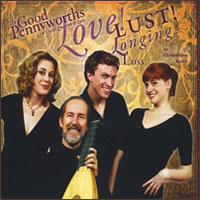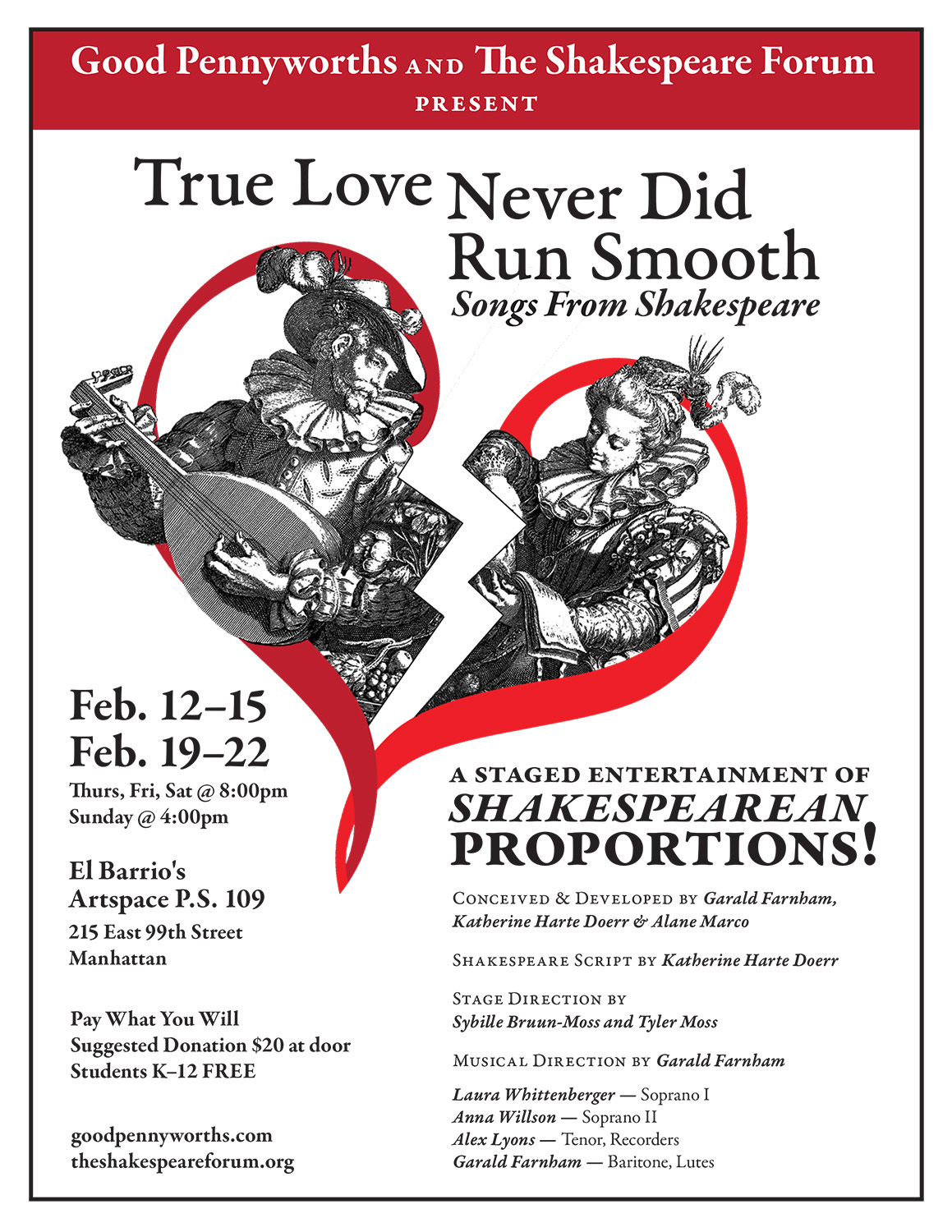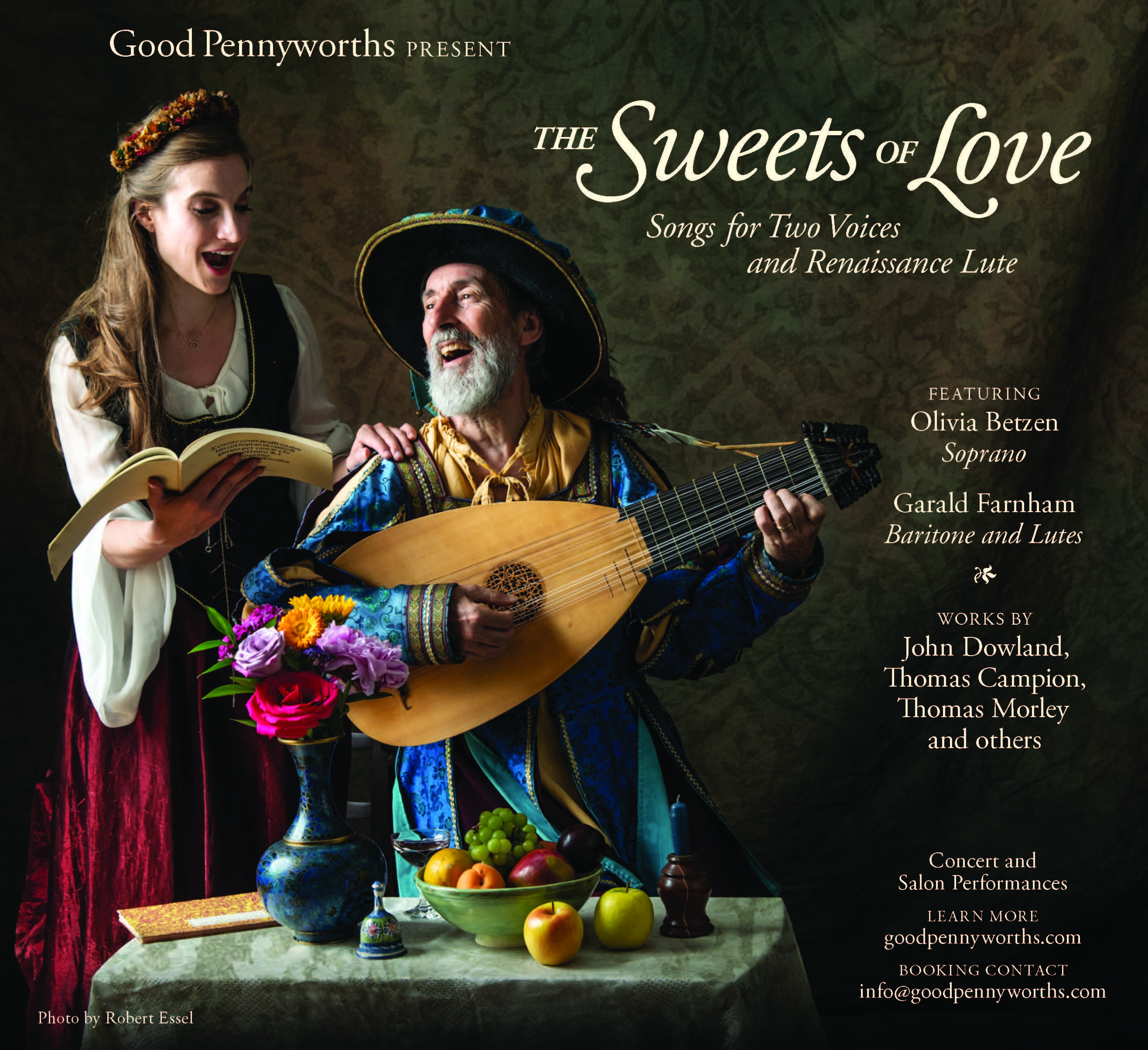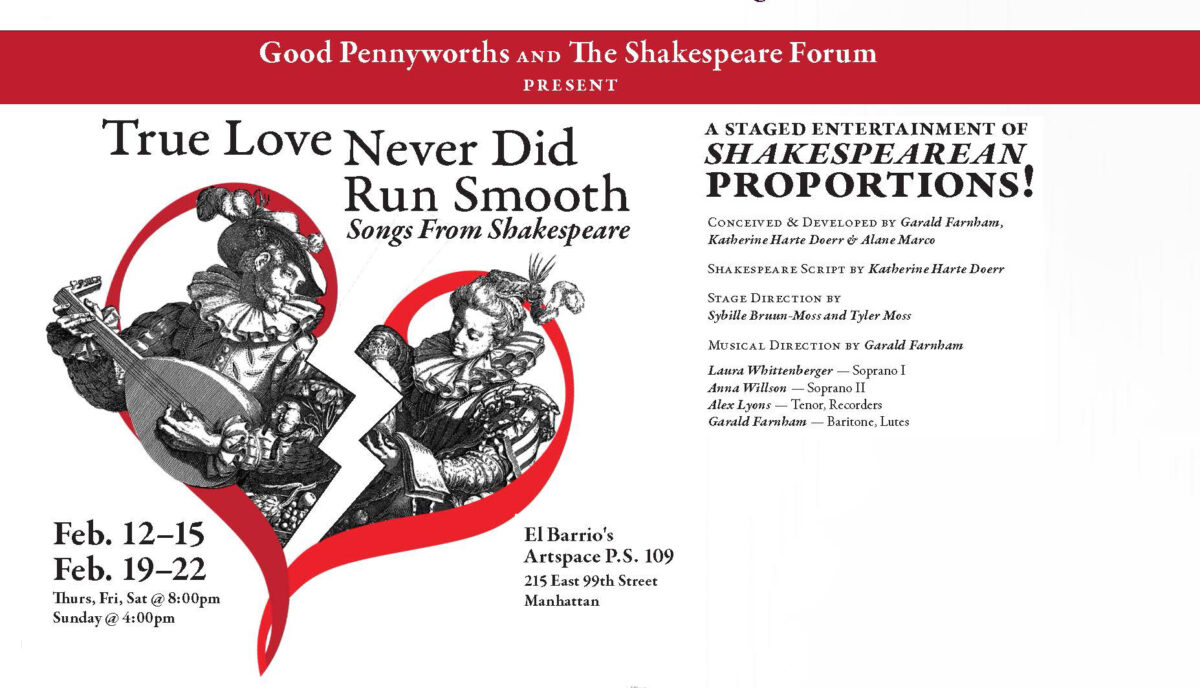
True Love Never Did Run Smooth: Songs from Shakespeare is an entertainment of Shakespearean proportions! In 1970, I left Ohio to pursue a career in music. I was looking for a way to accompany my singing. When I was hired at an amusement park for an arena show in 1974, I told the directors I also wanted to sing and began strolling the park as a minstrel. At that point I realized that the lute was the instrument that would fulfill my dreams. I have dedicated my life to studying and performing Renaissance lute songs and songs from the plays of Shakespeare. True Love Never Did Run Smooth is the culmination of my research and performing. Music for songs like Full Fathom Five survive in manuscript form whereas music for Orpheus with His Lute Made Trees does not. When no music survives, I have chosen to set Shakespeare’s words to existing Renaissance songs that fit the meter of his poetry. I am grateful to Laura, Anna and Alex for helping me share this music with all who will listen.
Come Unto These Yellow Sands (The Tempest, I.2, Ariel) set to John Dowland 1597
Come Unto These Yellow Sands welcomes the audience to a set of magic and music, the sprites dancing in a circle to confound the mortals. The original music does not exist. Garald set the lyrics to a four-part John Dowland song that fits the meter. This arrangement was performed live in concert by Laura Whittenberger, Anna Willson, Alex Lyons and Garald Farnham at El Barrio’s Artspace P.S. 109, NYC, on February 21, 2026.
Where the Bee Sucks (The Tempest, V.1, Ariel) by Robert Johnson ca. 1610
Where the Bee Sucks is one of a few songs that scholars believe to have been composed by Robert Johnson, the composer most closely associated with William Shakespeare, specifically for the original production of The Tempest. The play was performed for James I in 1611, when Johnson was active as a court musician. The song survives in various 17th c. manuscripts with melody and bass line, and was published in John Wilson’s Cheerfull Ayres or Ballads (1660). Garald arranged the four-part vocals for this setting that was performed live in concert by Laura Whittenberger, Anna Willson, Alex Lyons and Garald Farnham at El Barrio’s Artspace P.S. 109, NYC, on February 21, 2026.
Orpheus with His Lute (Henry VIII, III.1, a musician) set to Thomas Campion 1613
The original music for Orpheus with His Lute does not exist. This arrangement was set by Garald to a Thomas Campion song with four existing vocal parts. It was performed live in concert by Alex Lyons with Laura Whittenberger, Anna Willson, and Garald Farnham at El Barrio’s Artspace P.S. 109, NYC, on February 21, 2026.
Hark! Hark! the Lark (Cymbeline, II.3, a musician) by Robert Johnson ca. 1610
Hark! Hark! the Lark exists in manuscript form as a melody with bass line. The song is anonymous, but attributed to Robert Johnson on stylistic grounds since he was the composer most closely associated with William Shakespeare acting company, specifically for the original production of Cymbeline. Patrick O’Brien contributed additional voicing to the lute part. This arrangement was performed live in concert by Alex Lyons and Garald Farnham at El Barrio’s Artspace P.S. 109, NYC, on February 21, 2026.
When Daffodils Begin to Peer (The Winter’s Tale, IV.3, Autolycus) set to Thomas Robinson 1603
When Daffodils Begin to Peer is an autobiographical song, used as a soliloquy in the play to tell Autolycus’ back story and set the scene — the advent of spring. A ‘doxy’ is the vagabond’s unmarried female companion. ‘Pugging’ means thieving or cheating and the theft of the white sheets hanging on the line would provide the wherewithal to purchase a quart of ale. ‘Aunt’ here means merely a wanton woman, not a bawd or prostitute. No extant music survives, so Garald chose to set the text to an instrumental lute solo by Thomas Robinson which suits the lyrics quite well. He arranged the four vocal parts from Robinson’s lute harmony. This arrangement was performed live in concert by Laura Whittenberger, Anna Willson, Alex Lyons and Garald Farnham at El Barrio’s Artspace P.S. 109, NYC, on February 21, 2026.
It Was a Lover and His Lass (As You Like It, V.3, two Pages) by Thomas Morley 1600
It Was a Lover and His Lass was published by Thomas Morley in 1600, around the time of the first production of the play. The lyrics could be Morley’s, if not Shakespeare’s, and this tune is almost certainly the one performed in the original production. We are using Edward Naylor’s duet vocal arrangement published in 1927, with lute arrangement reworked from Morley’s by Garald Farnham and Patrick O’Brien. This arrangement was performed live in concert by Laura Whittenberger, Alex Lyons and Garald Farnham at El Barrio’s Artspace P.S. 109, NYC, on February 21, 2026.
Tell Me Where is Fancy Bred (Merchant of Venice, III.2, a musician) set to Thomas Campion 1618
Tell Me Where is Fancy Bred asks where does love (fancy) come from? Is it emotional (“in the heart”) or is it intellectual (“in the head”). The song answers that fancy begins in the eyes — not the heart or the head. However, it also dies there. Fancy can be deceiving, because it is based on outward beauty/appearance, rather than any inner qualities. In the play, the song gives Bassanio clues about which casket to choose (i.e. the plain, lead one). As no extant setting exists, Garald has set it to a lute song in four parts by Thomas Campion. This arrangement was performed live in concert by Anna Willson, and Garald Farnham at El Barrio’s Artspace P.S. 109, NYC, on February 21, 2026.
Lawn as White as Driven Snow (The Winter’s Tale, IV.3 , Autolycus) ca. 1615
Lawn as White as Driven Snow was published in John Wilson’s book, Cheerfull Ayres or Ballads (1660), and most people attribute it to him. The song exists in manuscript form for a melody with bass line. However, some scholar’s research suggests that the tune is earlier and may be by Robert Johnson. Since Johnson wrote a tune for ‘Get Ye Hence,’ which follows this song in the play, we assume that he probably wrote tunes for all of the songs in The Winter’s Tale. This arrangement was performed live in concert by Garald Farnham at El Barrio’s Artspace P.S. 109, NYC, on February 21, 2026.
Get Ye Hence (The Winter’s Tale, IV.3 , Autolycus, Dorcas, Mopsa) by Robert Johnson ca. 1610
Get Ye Hence is unusual in format. This song sounds more like operatic recitative than art song (though the subject matter is quite funny and undignified). Written by Robert Johnson, most likely for the original production, the song survives in manuscript form as a melody with bass line. Patrick O’Brien and Garald Farnham arranged the lute part we are using for this performance. This arrangement was performed live in concert by Laura Whittenberger, Anna Willson, Alex Lyons and Garald Farnham at El Barrio’s Artspace P.S. 109, NYC, on February 21, 2026.
Tomorrow is Saint Valentine’s Day (Hamlet, IV.5, Ophelia) anonymous tune before 1650
Tomorrow is Saint Valentine’s Day is one of Ophelia’s mad songs. It is set to the tune A Soldier’s Life and became associated with the song through late 18th century productions at the Drury Lane Theatre, with the pairing later published in Charles Knight’s Pictorial Edition of the Works of Shakespeare (1838–43). This tune does date to Shakespeare’s time. This arrangement was performed live in concert by Laura Whittenberger, Anna Willson, and Garald Farnham at El Barrio’s Artspace P.S. 109, NYC, on February 21, 2026.
The Willow Song (Othello, IV.3, Desdemona), anonymous ca.1583
The Poor Soul Sat Sighing is Shakespeare’s adaption of the lyrics of the original eight verse ballad for a woman to sing. He broke them up into the dialogue of a scene in Desdemona’s bedchamber. This anonymous tune for this text is found in manuscript form from the time period for voice with lute accompaniment. This arrangement was performed live in concert by Laura Whittenberger and Garald Farnham at El Barrio’s Artspace P.S. 109, NYC, on February 21, 2026.
Sigh no More, Ladies (Much Ado About Nothing, II.3, Balthazar) set to Thomas Ford 1607
The original music for Sigh no More, Ladies does not exist. Garald set the lyrics to four-part lute song by Thomas Ford that fits the meter. This arrangement was performed live in concert by Anna Willson with Laura Whittenberger, Alex Lyons and Garald Farnham at El Barrio’s Artspace P.S. 109, NYC, on February 21, 2026.
Light o’ Love (Much Ado About Nothing, III.4, Margaret, Beatrice) Anonymous ca. 1615
The title of this lute solo, Light of Love is mentioned by Margaret when she teases Beatrice for pretending to be sick. It is an anonymous tune found in the Margaret Board Lute Book. Margaret Board was the daughter of a wealthy merchant and a student of John Dowland. She collected many lute pieces — now considered masterworks of the Elizabethan and Jacobean eras — in her lute book. This arrangement was performed live in concert by Laura Whittenberger, Anna Willson, Alex Lyons and Garald Farnham at El Barrio’s Artspace P.S. 109, NYC, on February 21, 2026. It was choreographed by Chaeun Youn.
Farewell, Dear Love (Twelfth Night, II.3, Toby Belch, Feste) by Robert Jones 1600
Farewell, Dear Love was used as a banter between Sir Toby and Feste to tease Malvolio, in some of the cleverest words devised by the Bard. The song pre-existed the play and was already popular. Shakespeare took advantage of the fact that the audience knew the words and would get the references. We have taken the original Robert Jones song and turned it into a little four-character opera buffo about two lovers having a tremendous fight. This arrangement was performed live in concert by Alex Lyons, Anna Willson, Laura Whittenberger and Garald Farnham at El Barrio’s Artspace P.S. 109, NYC, on February 21, 2026.
Take, O Take Those Lips Away (Measure for Measure, IV.1, a boy) by John Wilson? ca. 1615
The first verse of Take, O Take Those Lips Away is arguably by Shakespeare, written to advance the plot of the play, while second verse is from The Bloody Brother by John Fletcher. This setting was published by John Wilson in Cheerfull Ayres (1660). Scholars guess that Wilson wrote it for a revival, as Wilson would have been a mere stripling when the play was first produced, or that it is Wilson’s reworking of an earlier Robert Johnson tune. (John Wilson was Johnson’s successor as resident composer for Shakespeare’s company and likely had access to Johnson’s old manuscripts.) This arrangement was performed live in concert by Alex Lyons and Garald Farnham at El Barrio’s Artspace P.S. 109, NYC, on February 21, 2026.
Blow, Blow Thou Winter Wind (As You Like It, II.7, Amiens) John Danyel 1606
The original music for Blow, Blow Thou Winter Wind does not exist. The lyrics were first paired with John Danyel’s lute song by an English group in the 1950s. Garald used the original Danyel source for the four vocal parts, and Patrick O’Brien contributed to the lute accompaniment. This arrangement was performed live in concert by Anna Willson, with Laura Whittenberger, Alex Lyons and Garald Farnham at El Barrio’s Artspace P.S. 109, NYC, on February 21, 2026.
And Will He Not Come Again (Hamlet, IV.5, Ophelia) Anonymous ca. 1600
Another of Ophelia’s ‘mad songs,’ And Will He Not Come Again is a 17th c. variant of The Merry, Merry Milkmaids from the Playford book of country dances (1651). The variant is in a minor key, which makes sense given the subject matter of the song. The source for this pairing is again Charles Knight (1838–43), from original Drury Lane Theatre records dating to the late 1700s. This arrangement was performed live in concert by Laura Whittenberger with Anna Willson, Alex Lyons, and Garald Farnham at El Barrio’s Artspace P.S. 109, NYC, on February 21, 2026.
Full Fathom Five (The Tempest, I.2, Ariel) by Robert Johnson ca. 1610
Full Fathom Five is another song very likely to have been used in the original production of The Tempest. It survives in manuscript form as a melody and bass line. Garald arranged the four-part vocals. The play was performed for James I in 1611, when Johnson was active as a court musician. This arrangement was performed live in concert by Laura Whittenberger, Anna Willson, Alex Lyons and Garald Farnham at El Barrio’s Artspace P.S. 109, NYC, on February 21, 2026.
Fear No More the Heat o’the Sun (Cymbeline, IV.2, Guiderius/Arviragus) set to John Dowland 1600
There is no extant music for Fear No More the Heat o’the Sun and no suggestion of an older pairing survives. Garald has set the text to a lesser-known four-part lute song by Dowland which suits the theme and scansion of the lyrics. This arrangement was performed live in concert by Alex Lyons, Laura Whittenberger, Anna Willson and Garald Farnham at El Barrio’s Artspace P.S. 109, NYC, on February 21, 2026.
Jog On (The Winter’s Tale, IV.3, Autolycus) Anonymous ca. 1600
Jog On is set to a variation of the tune known as Jog On in John Playford’s book of country dances (1651) or as Hanskin in Queen Elizabeth’s Virginal Book. This tune was adapted by John Hilton for the Shakespeare text and it was probably used in a revival. Garald arranged the four vocal parts from the earliest known setting of the tune, a harpsichord solo with no text. This arrangement was performed live in concert by Laura Whittenberger, Anna Willson, Alex Lyons and Garald Farnham at El Barrio’s Artspace P.S. 109, NYC, on February 21, 2026.
Three Merry Men/Hold Thy Peace (Twelfth Night, II.3, Aguecheek, Belch, Feste) Anonymous
Three Merry Men/Hold Thy Peace were popular silly ‘catches’ of the time. Elizabethans loved double entendres and Shakespeare took advantage of that when he inserted these tunes in the drunken madness of Sir Toby Belch. Settings of the texts with music exist in manuscript form for Three Merry Men. Hold thy peace was published by Thomas Ravencroft in 1609, but whether he actually wrote the tune is not known. This arrangement was performed live in concert by Anna Willson, Alex Lyons and Garald Farnham at El Barrio’s Artspace P.S. 109, NYC, on February 21, 2026.
Under the Greenwood Tree (As You Like It, II.5, Amiens v1&2) set to John Bartlett 1606
No music survives for Under the Greenwood Tree. The lyrics were first paired with John Bartlett’s lute song by an English group in the 1950s. Garald used the original Bartlett source for the four vocal parts. This arrangement was performed live in concert by Laura Whittenberger, Anna Willson, Alex Lyons and Garald Farnham at El Barrio’s Artspace P.S. 109, NYC, on February 21, 2026.
When That I Was a Little Tiny Boy (Twelfth Night, V.1, Feste) Anonymous
The traditional setting for When That I Was a Little Tiny Boy which we sing was in vogue by 1800. Although the text is definitely by Shakespeare, the original musical setting is lost. Garald arranged the 4-part vocals for the epilogue to Twelfth Night. This arrangement was performed live in concert by Alex Lyons, Laura Whittenberger, Garald Farnham and Anna Willson at El Barrio’s Artspace P.S. 109, NYC, on February 21, 2026.